
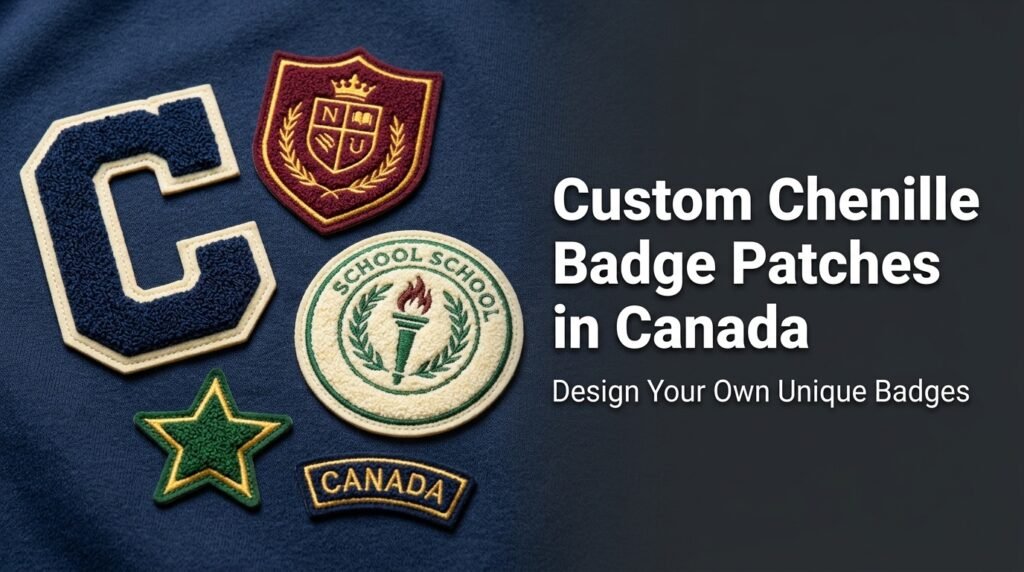
Quick Answer: Custom chenille badge patches are soft, raised patches made with thick chenille yarn. They give a bold, textured look that works well on jackets, bags, and uniforms. Canadian schools, sports teams, clubs, and brands use them to add a classic varsity-style badge with their own design, letters, or logo.
Key Takeaway: If you want a badge with a raised, fuzzy texture and a bold varsity feel, custom chenille badge patches are a good choice. They work well for team names, letters, numbers, and simple logos, and can be made in Canada with sew-on, iron-on, or hook-and-loop backing.
What Are Custom Chenille Badge Patches?
Chenille is a type of yarn with a soft, fuzzy pile. It is made by twisting short fibres between two core threads, which creates a raised, velvety surface. This is the same texture you see on classic varsity letters.
A custom chenille badge patch uses this yarn to build up letters, numbers, or shapes on a fabric backing. The result is a patch with visible height and texture, unlike a flat printed or woven patch.
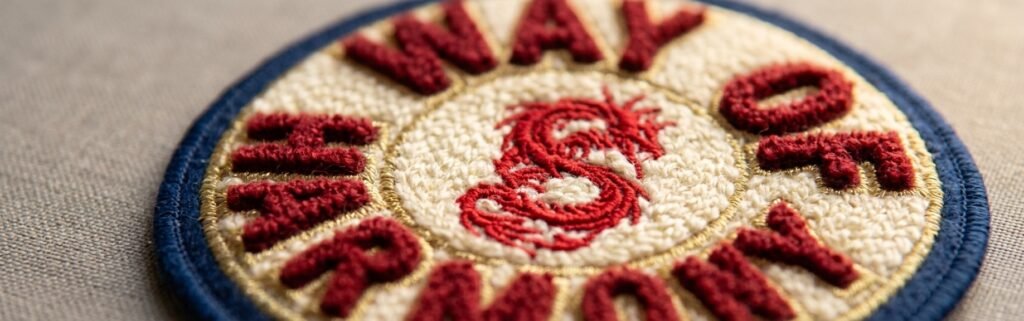
Chenille badges differ from flat patches in a few ways:
- The surface stands up from the fabric instead of lying flat.
- Colours look bold because the yarn catches light differently.
- Fine detail is harder to achieve than with embroidery, so designs are usually kept simple and bold.
This texture is why chenille patches work so well for badges. They stand out, they feel substantial, and they carry a traditional, collegiate look that many Canadian schools and teams recognise.
Why Choose Custom Chenille Badge Patches?
Chenille badge patches give a soft, raised texture that flat patches cannot copy. This makes them a strong choice for anyone who wants a bold, classic look rather than a plain printed badge.
Some of the main reasons people choose chenille for their custom badges include:
- Soft raised texture – patches feel thick and tactile, not flat.
- Bold appearance – colours and shapes are easy to see from a distance.
- Custom colours – yarn can be matched to team colours, school colours, or brand colours.
- Custom lettering – initials, team names, or graduation years are common.
- Logos and mascots – simple logo shapes can be recreated in chenille.
- Numbers – jersey numbers or class years are popular on varsity-style jackets.
- Classic varsity look – this style has been used on letterman jackets for decades.
Because of this look, chenille badges are often chosen for jackets first, but they are not limited to jackets. They also work on bags, caps, and uniform pieces where a bold badge is wanted.
Can You Make a Chenille Badge From Your Own Design?
Yes. You can send your own logo, artwork, letters, or numbers, and have it turned into a custom chenille badge patch. Very detailed designs are usually simplified so the shapes work well in raised yarn.
Chenille is a textured material, so it does not reproduce fine detail the way embroidery or print can. Before production, most designs go through a simplification step. This can include:
- Reducing small text to a size that will still be readable.
- Simplifying complex logos into bolder shapes.
- Reducing the number of colours if the original design has many fine gradients.
- Turning thin lines into slightly thicker ones so they show up clearly.
A digital proof is normally created before production starts. This proof shows how your design will look once it is made in chenille. Reviewing this proof carefully is one of the most useful steps in the whole process, since it lets you check spelling, colours, and shape before anything is produced.
Where Can You Use Chenille Badge Patches?
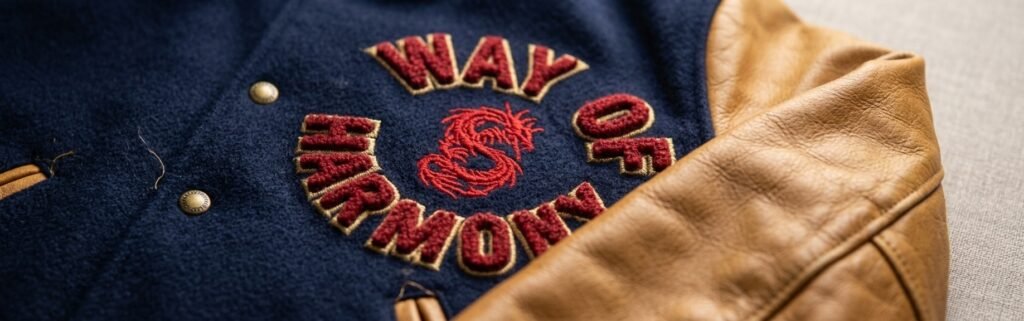
Chenille badge patches are used on jackets, bags, uniforms, and other clothing where a raised, textured badge is wanted. They suit both individual and group orders.
Varsity and Letterman Jackets
This is the most traditional use. School initials, sport names, and graduation years are commonly added as chenille badges on the chest or sleeve of a letterman jacket.
Sports Teams
Canadian sports teams and clubs use chenille badges for team names, numbers, and mascots. They can be added to jackets, warm-up gear, or team bags.
Schools and Clubs
Schools and student clubs use chenille badges for house colours, club names, or achievement badges. They give a recognisable, consistent look across a group.
Clothing Brands
Some Canadian clothing brands use chenille patches as a design feature on jackets, hoodies, or caps, since the raised texture adds visual interest to plain fabric.
Bags and Backpacks
Chenille patches for bags are popular for adding initials, symbols, or small logos to backpacks, duffel bags, and tote bags.
Uniforms and Group Clothing
Group uniforms, such as those for clubs or workwear with a casual style, sometimes use chenille badges to mark team names or roles.
What Sizes and Shapes Can Chenille Badges Have?
Chenille badges can be made in many shapes, including round, oval, square, rectangle, shield, letter shapes, and number shapes. The right size depends on your design and where the badge will be placed.
Common shape options include:
- Round or oval badges for crests and logos
- Square or rectangle badges for text or club names
- Shield shapes for a school-crest style look
- Individual letter or number shapes for initials and jersey numbers
- Custom logo shapes cut to match your artwork
A badge for a jacket chest is usually larger than one meant for a bag or cap. There is no single correct size. It depends on the design, the amount of text, and the space available on the item.
How Do You Attach a Chenille Badge?
Chenille badges can be attached using sew-on, iron-on, or hook-and-loop backing. The right choice depends on how the badge will be used and whether it needs to be removable.
- Sew-on – the badge is stitched onto the fabric. This is a common choice for jackets and items that will not need the badge removed.
- Iron-on – the badge has a heat-activated adhesive backing. This can be a convenient option for lighter use on suitable fabrics.
- Hook-and-loop (Velcro-style) – the badge can be attached and removed as needed. This suits items where you may want to swap badges, such as bags or removable panels.
Each backing type suits different needs, so it is worth thinking about how the badge will be used before choosing.
Chenille vs Embroidered Patches
Chenille and embroidered patches both create custom badges, but they look and feel different. The table below compares the two so you can decide which suits your project.
| Feature | Chenille Patches | Embroidered Patches |
|---|---|---|
| Texture | Soft, raised, fuzzy | Flat, stitched surface |
| Appearance | Bold, chunky, varsity style | Detailed, crisp lines |
| Level of detail | Best for simple, bold designs | Better for fine detail and small text |
| Best use | Letters, numbers, team names, mascots | Logos with fine detail, small text, complex artwork |
| Overall style | Classic, retro, collegiate | Clean, modern, precise |
Neither option is always better. If you want a bold, textured badge with a varsity feel, chenille is a strong fit. If your design has fine detail or small text, embroidery may reproduce it more accurately. Embroidered Patches can help if you are comparing both options for your project.
How Much Do Custom Chenille Badge Patches Cost in Canada?
The cost of custom chenille badge patches depends on several factors, including size, quantity, number of colours, and design complexity. There is no fixed price that applies to every order, since each design is different.
Factors that typically affect price include:
- Size – larger badges use more material and take longer to produce.
- Quantity – ordering more badges usually lowers the price per badge.
- Number of colours – more colours can add production steps.
- Design complexity – detailed shapes may need extra work to simplify or produce.
- Extra embroidery – some badges combine chenille with embroidered detail, which can affect cost.
- Border – a merrowed or stitched border adds a finishing step.
- Backing type – sew-on, iron-on, and hook-and-loop can affect price differently.
- Production requirements – rush timelines can also affect cost.
For an accurate price, it is best to request a quote based on your actual design, size, and quantity.
How Do You Order Custom Chenille Badge Patches in Canada?
Ordering custom chenille badge patches in Canada usually follows a simple process, from preparing your design to approving the final proof before production.
- Prepare your design – send your logo, text, or artwork idea.
- Choose size – decide on the badge size based on where it will be worn.
- Select colours – pick colours to match your team, school, or brand.
- Choose backing – decide between sew-on, iron-on, or hook-and-loop.
- Request and review a proof – check the digital mock-up carefully.
- Approve production – once the proof looks right, production can begin.
Working through these steps in order helps avoid mistakes and gives you a clear badge before it goes into production.
What Should You Check Before Ordering?
Before placing an order, it helps to review the design proof carefully using a simple checklist. This catches most mistakes before production starts.
- Spelling of all text and names
- Colours match what you expect
- Size is correct for the intended use
- Shape matches your design
- Small details are simplified but still recognisable
- Backing type is correct for your item
- Quantity is correct
- Final proof has been approved in writing
Learn More About What Is Chenille Material? A Complete Guide To Chenille Patches
FAQ
Are chenille badge patches soft? Yes. Chenille yarn has a soft, fuzzy texture, which is why it feels different from a flat embroidered or printed patch.
Can I put my logo on a chenille badge? Yes, but detailed logos are usually simplified into bolder shapes so they work well in raised chenille yarn.
Are chenille badges good for varsity jackets? Yes. Chenille is the traditional material used for varsity and letterman jacket badges, especially for letters and numbers.
Can I order custom chenille badges in Canada? Yes. Custom chenille badge patches can be ordered by individuals, schools, teams, and businesses across Canada.
Can chenille badges have multiple colours? Yes. Multiple chenille colours can be combined in one badge, though very high colour counts may need to be simplified.
What backing should I choose? This depends on how the badge will be used. Sew-on suits permanent placement, iron-on suits light use, and hook-and-loop suits removable badges.
Can chenille patches be used on bags? Yes. Chenille patches for bags are a common way to add initials, symbols, or small logos to backpacks and totes.
Can small text be used on chenille badges? Small text can be difficult to reproduce clearly in chenille. Larger, bolder lettering usually works better than fine, small text.
How long does a chenille badge order take to produce? Production time depends on the supplier, order size, and design complexity. It is best to confirm timelines directly when requesting a quote.
Can chenille badges be shaped like letters or numbers? Yes. Individual letter and number shapes are a common style, often used for jersey numbers or initials on jackets.
Final Takeaway
Custom chenille badge patches give a soft, raised, bold look that suits jackets, bags, and uniforms. They work well for letters, numbers, team names, and simple logos, and they can be made with sew-on, iron-on, or hook-and-loop backing to suit different needs. Canadian schools, sports teams, clubs, and brands regularly use them for badges that stand out.
If you have a design in mind, you can request a quote or explore Custom Chenille Patches options to see how it would look as a chenille badge.