
Introduction
If you’ve ever ironed a patch onto a jacket only to watch it peel off after a few washes, you already understand why so many Canadian businesses, teams, and uniformed services have switched to velcro patches. It isn’t a trend — it’s a practical fix for a real problem: patches that need to come off, get swapped, or survive years of hard use without falling apart.
Custom velcro patches, also known as hook and loop patches, have become the standard across Canada for police services, security companies, motorcycle clubs, sports teams, event organizers, and businesses that need patches to move between garments or gear. Most buyers, though, don’t fully understand how hook and loop backing actually works, which side goes where, whether velcro patches can be washed, or what separates a good velcro patch from a poorly made one.
This guide answers all of it — in plain language, with real comparisons, so you can order with confidence instead of guessing.
Table of Contents
- What Are Velcro Patches?
- How Do Velcro Patches Work?
- What Is Hook and Loop Backing?
- Types of Custom Velcro Patches
- Embroidered Velcro Patches vs. PVC Velcro Patches
- Common Uses of Velcro Patches in Canada
- Choosing the Right Size and Backing
- Velcro vs. Sew-On vs. Iron-On Patches
- Are Velcro Patches Reusable?
- Can Velcro Patches Be Washed? How to Clean Them
- How to Attach Velcro Patches
- Design Tips Before Ordering
- Common Mistakes to Avoid
- Ordering Custom Velcro Patches in Canada
- Expert Buying Advice
- Conclusion
- FAQs
What Are Velcro Patches?
A velcro patch is a custom patch — embroidered, PVC, woven, or another material — that attaches to clothing or gear using a hook and loop fastener instead of iron-on adhesive or thread. One side of the fastener, the hook side, is stitched to the back of the patch. The other side, the loop side, is sewn onto the garment or gear itself. Press them together and the patch locks into place. Pull them apart and it releases cleanly, ready to be repositioned or swapped for a different design entirely.

That single feature — removability — is what separates a velcro patch from every other patch style, and it’s why personalized velcro patches have become the default choice for uniform programs, tactical gear, and anything where a patch needs to change over time.
How Do Velcro Patches Work?
The mechanics are simpler than most people expect, but getting the direction right matters. The hook side, the rough and scratchy half, is almost always attached to the back of the patch. The loop side, the soft and fuzzy half, is sewn onto the garment or gear — the jacket, vest, cap, or bag.
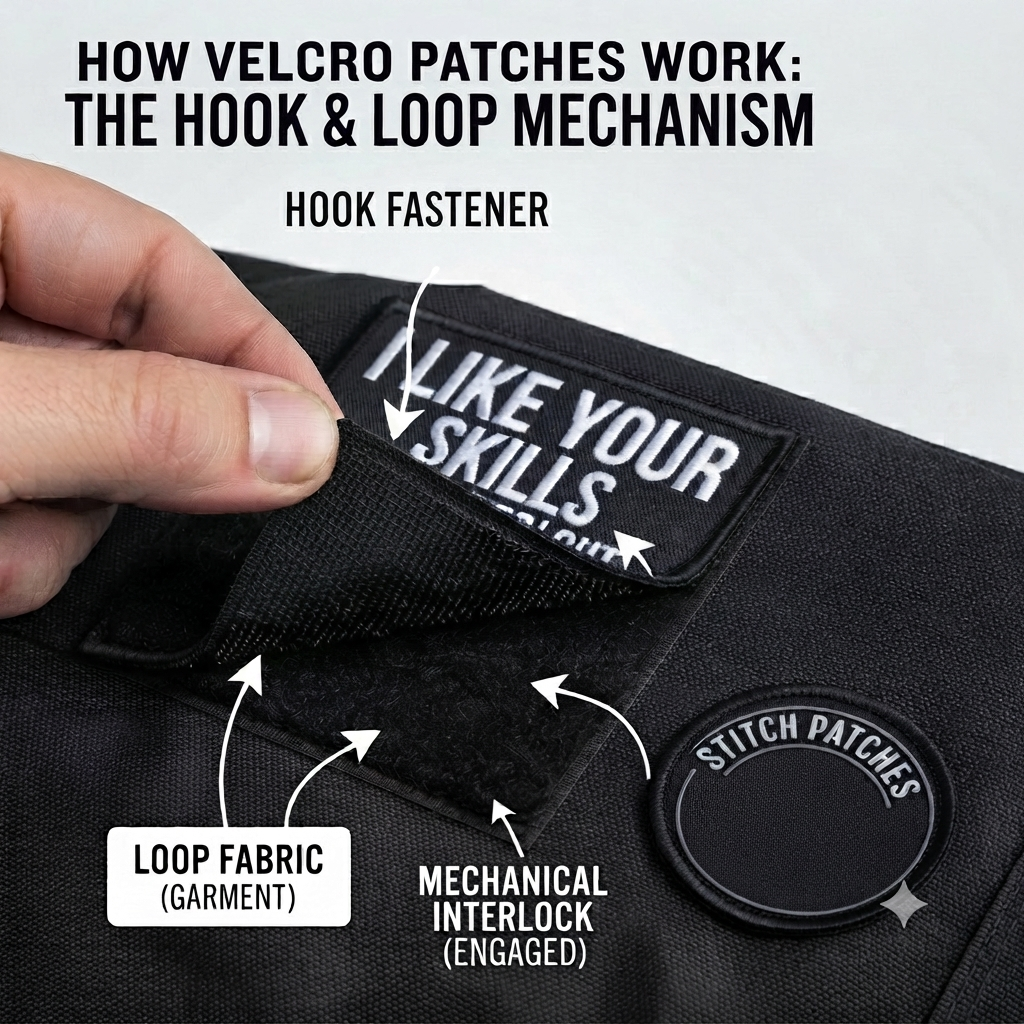
When pressed together, thousands of tiny hooks catch onto the loop fibers, creating a mechanical bond strong enough to hold through movement, wind, and daily wear, but that releases cleanly with a firm pull. There’s no adhesive, no heat, and no permanent thread holding the patch itself — only the loop panel on the garment is sewn on once, and everything after that is attach-and-remove.
What Is Hook and Loop Backing?
Hook and loop backing is simply the technical name for the two-part fastener system used on velcro patches. “Hook and loop” and “velcro” are used interchangeably in the patch industry, though Velcro is technically a brand name that became the common word for the fastener type — much like how people say “Kleenex” for facial tissue.
Hook and loop backing adds a small amount of extra thickness to a patch — typically around 2mm once both the hook backing and the corresponding loop panel are factored in. For most everyday applications this is unnoticeable. For patches going into tight MOLLE webbing or a snug uniform slot on tactical patches, it’s worth confirming the fit before ordering in bulk.
Expert tip: If you’re outfitting a team or department, sew the loop panel onto every garment at the same size and position. Inconsistent loop-panel placement is the single most common reason Custom Patches Canada end up sitting crooked across a group order.
Types of Custom Velcro Patches
Velcro is a backing choice, not a material — almost any patch material can be made with hook and loop backing attached to it:
- Embroidered velcro patches — raised thread texture, classic look, the most popular option for logos, team names, and unit identifiers
- PVC velcro patches — molded, rubber-like material, waterproof, ideal for outdoor and tactical use
- Woven patches — thinner threads than embroidery, sharper detail for small text or fine designs
- Chenille patches — thick, textured, varsity-style look
- Leather patches — durable, premium feel, common on outerwear and branded goods
Embroidered Velcro Patches vs. PVC Velcro Patches
These two are the most requested options for Canadian buyers, and they solve genuinely different problems.
| Feature Embroidered Velcro Patch PVC Velcro Patch |
|---|
| Look and feel | Raised thread texture, classic patch look | Smooth, molded rubber-like finish |
| Best for | Logos, lettering, team and unit identifiers | Outdoor, tactical, and high-moisture use |
| Weather resistance | Good, though thread can fray over years of heavy exposure | Excellent — waterproof and fade-resistant |
| Detail level | Great for bold designs and text | Great for fine detail, gradients, and 3D effects |
| Typical use case | Uniforms, jackets, team apparel | Airsoft, security gear, marine and outdoor equipment |
Real example: A security company outfitting staff for outdoor patrols will usually choose PVC velcro patches for durability in wet Canadian weather. A motorcycle club focused on a classic embroidered look will typically stick with embroidered velcro patches instead.
Common Uses of Velcro Patches in Canada
Custom velcro patches show up across a wide range of Canadian industries and communities, each with a slightly different reason for choosing removable backing over a permanent one:
- Police, security, and EMS — badge IDs and role designations that need to change as personnel shift roles or locations
- Military and tactical use — military velcro patches, name tapes, unit identifiers, and morale patches designed to be swapped quickly
- Motorcycle clubs — chapter patches, event patches, and territory markers that riders update over time
- Sports teams and event organizers — seasonal team names, sponsor logos, and event-specific badges
- Businesses and clothing brands — branded apparel where a logo needs to move between uniforms or seasonal collections
Modern Canadian military uniforms, including CADPAT gear, use hook and loop backing as the standard method for attaching rank, unit, and identifier badges, because it allows fast changes without re-stitching a uniform. This matters if you’re ordering for a uniformed team: velcro isn’t a shortcut, it’s the method regulated services already rely on. Note that official rank insignia and government-issued badges require proper authorization and aren’t a standard custom order.
Choosing the Right Size and Backing
Size and backing decisions should be made together, not separately, since the wrong combination is one of the most common ordering mistakes.
Common patch sizes:
| Use Case Typical Size | |
| Name tape or call sign | 1″ x 3.5″ to 1″ x 4″ |
| Small logo or emblem | 2″ to 3″ round or square |
| Chest badge | 3″ to 4″ |
| Back patch (jacket or vest) | 8″ to 12″+ |
Backing comparison:
| Velcro (hook and loop) | Yes, unlimited swaps | Slightly higher | Uniforms, gear needing frequent changes |
| Iron-on | No | Lowest | Casual apparel, home application |
| Sew-on | No | Similar to iron-on | Heavy-wash workwear, long-term wear |
| Adhesive / peel-and-stick | Limited | Slightly higher | Temporary or one-time use |
Velcro backing typically adds $0.30 to $0.65 per patch over iron-on or sew-on, depending on size and order volume, to cover the extra material and the added manufacturing step. It’s a fair trade for the flexibility it provides, and it’s better to know that upfront than be surprised by it on a quote.
Velcro vs. Sew-On vs. Iron-On Patches
This is one of the most searched comparisons in the entire patch industry, and the honest answer is: it depends on how the patch needs to behave over time.
- Velcro is the right call when a patch needs to come off — a role changes, a season ends, a design updates, or the patch simply needs to move between different pieces of gear.
- Sew-on is the most permanent and durable option, holding up through heavy wash cycles and years of wear, but it isn’t removable without unpicking thread.
- Iron-on is the fastest and cheapest to apply at home, works well on cotton, denim, and canvas, but isn’t reliable on heat-sensitive fabrics and tends to loosen over repeated washing.
Simple decision rule: if the patch ever needs to come off, choose velcro. If it’s going on once for the life of the garment, sew-on or iron-on will save a small amount per unit.
Are Velcro Patches Reusable?
Yes — reusability is the entire point of hook and loop backing. A velcro patch can be attached and removed repeatedly without damaging the patch itself, which is why it’s the standard choice for morale patches, collectible patch panels, and any uniform program where identifiers change over time. The loop side sewn onto the garment is the part that experiences the most wear with heavy, repeated use, not the hook side on the patch.
Can Velcro Patches Be Washed? How to Clean Them
Velcro patches should be removed before washing whenever possible. Leaving a velcro patch attached during a wash cycle causes lint and fabric fibers to build up in the loop side, which gradually weakens the hold over time. To clean a velcro patch itself, a soft brush or a strip of tape gently pressed and lifted off the hook side will pull out trapped lint and restore most of the original grip. For the patch face, a damp cloth is usually enough — avoid soaking embroidered patches, and avoid high heat on PVC patches.
How to Attach Velcro Patches
- Sew the loop side (soft) onto the garment or gear in the desired position
- Confirm the placement is even and consistent, especially for team or department orders
- Press the hook side of the patch firmly onto the loop panel
- Smooth from the center outward to ensure full contact across the fastener
No iron, no adhesive, and no special tools are required — the fastener does the work.
Design Tips Before Ordering
- Keep text legible at final size, since fine detail that looks great on a screen can disappear once shrunk to a 2-inch patch
- Limit your color count where possible, since fewer colors generally means cleaner embroidery and faster production
- Choose your border style intentionally — a merrow (stitched) border suits standard shapes, while a laser-cut border is better for detailed or irregular outlines
- Confirm loop-panel placement in advance for team or department orders so every garment lines up consistently
- Always request a digital proof before production, even on a repeat order
Common Mistakes to Avoid
- Not specifying hook or loop clearly — confirm which side goes where before production, not after delivery
- Ignoring backing thickness in tight spaces — check fit against MOLLE webbing or uniform slots before a bulk order
- Washing garments with the patch still attached — remove it first to avoid lint buildup and a weakened hold
- Assuming velcro is always the cheapest option — budget for the small per-unit premium upfront
- Skipping the proof stage to save time — this almost always costs more time later if something needs adjusting
- Not confirming who actually manufactures the patch — some Canadian-branded patch sites are storefronts for manufacturers based outside Canada
Ordering Custom Velcro Patches in Canada
- Submit your design — a logo, sketch, or existing patch to match
- Choose your material and backing — embroidered, PVC, woven, plus velcro backing specified
- Approve a digital proof — review size, colors, and layout before production starts
- Production and quality control — the hook backing is attached and the patch is inspected
- Shipping across Canada — confirm turnaround time and whether shipping is domestic
Most Canadian manufacturers offer no minimum order requirement, with turnaround typically running one to two weeks depending on design complexity and quantity. If you’re ordering for an organization, ask whether your design and specs are kept on file — this makes reordering matching patches months or years later far simpler than starting from scratch.
Expert Buying Advice
- Order one sample before committing to a large batch — color and texture can look slightly different in person than on a screen
- For regulated uniforms, always check your governing body’s dress standard first, then choose backing and design to match
- Buy slightly more than you need for team or department orders, since personnel changes and a few spares save a future reorder
- If frequent changes are part of your plan, velcro pays for itself — the small per-patch premium is minor compared to reordering an entirely new patch every time a design updates
Conclusion
Custom velcro patches solve a specific, practical problem: the need for a patch that can move, swap, or update without damaging the garment underneath. Once you understand how hook and loop backing actually works, which materials suit your use case, and what to expect in terms of cost and care, ordering becomes a straightforward decision instead of a guessing game.
Whether you’re outfitting a police unit, a motorcycle club, a sports team, or a growing business, the right combination of material, size, and backing will hold up to real Canadian use — through winters, patrols, rides, and seasons — while giving you the flexibility to update your patches whenever your needs change.
FAQs
Velcro is generally the best choice for uniform programs where roles, ranks, or identifiers change over time, since it avoids re-stitching the garment each time.
Hook and loop backing is widely used across Canadian uniformed services, including on CADPAT uniforms, but you should always confirm your specific department’s dress standard first.
Velcro patches are custom patches attached using a two-part hook and loop fastener instead of iron-on adhesive or thread, allowing them to be attached and removed repeatedly.
Tiny hooks on the back of the patch catch onto soft loop fibers sewn onto the garment, creating a strong mechanical bond that releases cleanly with a firm pull.
It’s the technical term for the velcro fastener system — a hook side on the patch and a loop side on the garment that press together to hold the patch in place.
Yes, that’s their main advantage — they can be attached, removed, and reattached many times without damaging the patch.
It’s the technical term for the velcro fastener system — a hook side on the patch and a loop side on the garment that press together to hold the patch in place.
Yes, that’s their main advantage — they can be attached, removed, and reattached many times without damaging the patch.
It’s best to remove a velcro patch before washing. Leaving it attached during laundering causes lint to build up on the loop side and weakens the hold over time.
Sew the loop side onto the garment first, then press the hook side of the patch firmly onto the loop panel, smoothing from the center outward.
Common uses include police and security uniforms, military and tactical gear, motorcycle club vests, sports team apparel, and branded business uniforms.
Sew-on is more permanent and durable for garments that won’t change, while velcro is better when the patch needs to be removed or swapped over time.