
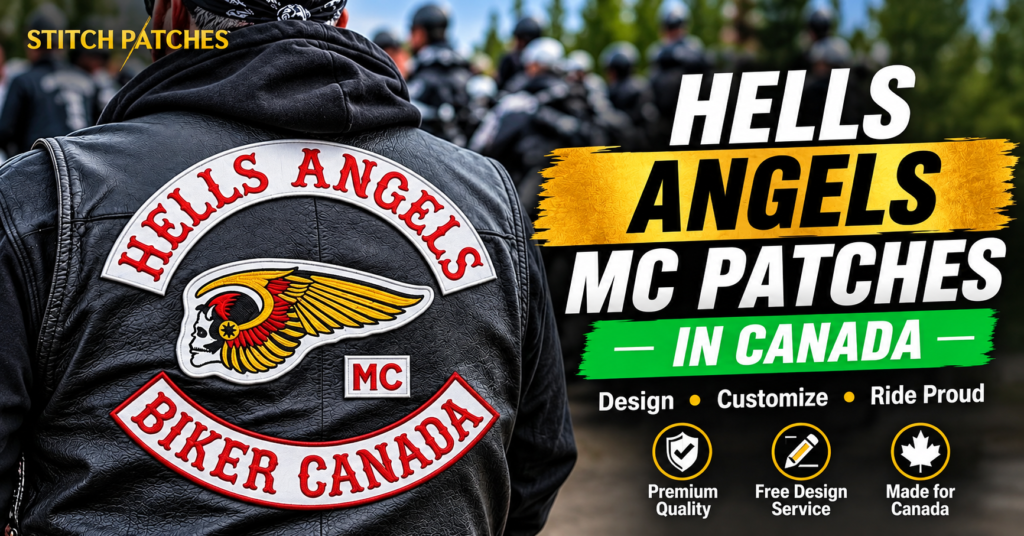
Quick answer: Hells Angels MC patches are the insignia on the back of a member’s vest, or “cut.” The full set has a top rocker reading “HELLS ANGELS,” the winged-skull Death Head in the centre, a bottom rocker naming the chapter’s territory, and a small “MC” tab. Add-on patches such as 81, AFFA and the 1% diamond carry further meanings. The club’s name and Death Head are protected marks, so they aren’t designs for other makers to copy.
Key takeaway: Some patch meanings are well documented, like the layout of the set, what 81 stands for, and AFFA. Others, including the origin of the 1% diamond and the so-called achievement patches, rest on police evidence, court testimony and folklore. This article marks which is which.
A leather or denim vest tells other riders who you ride with before you say a word. In motorcycle club culture, the patches on it work like a uniform and a résumé at once. Hells Angels patches are among the most recognised in North America, and among the most misreported.
This guide covers what the main patches mean, how three-piece patches work across clubs, where the Hells Angels fit into Canadian history, and what separates studying these patches from making your own. It’s educational. Stitch Patches Canada has no affiliation with the Hells Angels, and nothing here endorses any club.
A note on words: Canadians often write “colours” and “chapter.” The Hells Angels themselves say “charter.” Both appear below.
What Are Hells Angels MC Patches?
Hells Angels MC patches are the embroidered insignia worn by members of the Hells Angels Motorcycle Club on a sleeveless vest or jacket. Together they identify the wearer’s club and chapter. Smaller add-ons can signal rank or personal status. Riders call the whole set “colours.”
The club is usually dated to 1948 in Fontana, California, though early records are thin and accounts differ. It spread through California charters in the 1950s and opened its first charter outside the United States in New Zealand in 1961. It reached Canada in 1977, when a Montreal club, the Popeye Moto Club, patched over. Its official colours are red lettering on white, which gives the nickname “Red and White.”
The club doesn’t publish a patch dictionary. What the public knows comes from the club’s own website, court records, police and prosecution evidence, and journalism. That’s why even researchers disagree about the smaller patches.
What Do the Main Hells Angels Patch Symbols Mean?
A full Hells Angels set has four pieces: the club name on top, the Death Head in the centre, a territory rocker below, and an MC tab. Smaller patches add other messages. This table separates what’s documented from what’s interpreted.
| Patch | What it shows | What’s known | Confidence |
|---|---|---|---|
| Top rocker | “HELLS ANGELS,” red on white | Part of the full-member set | High |
| Death Head | Winged skull in an aviator-style helmet | The club’s central emblem and a protected mark | High (design origin disputed) |
| Bottom rocker | The chapter’s territory | Names the place the chapter represents | High |
| MC patch | Small rectangular “MC” | Short for motorcycle club | High |
| 81 | The number, in red and white | H is the 8th letter, A is the 1st | High |
| AFFA | Four letters | “Angels Forever, Forever Angels”; the club’s motto | High |
| 1% diamond | Diamond reading “1%” | Marks an outlaw identity; popular origin story unverified | Medium |
| Filthy Few, Dequiallo | Small lettered patches | Meanings contested | Low |
Top Rocker Patch
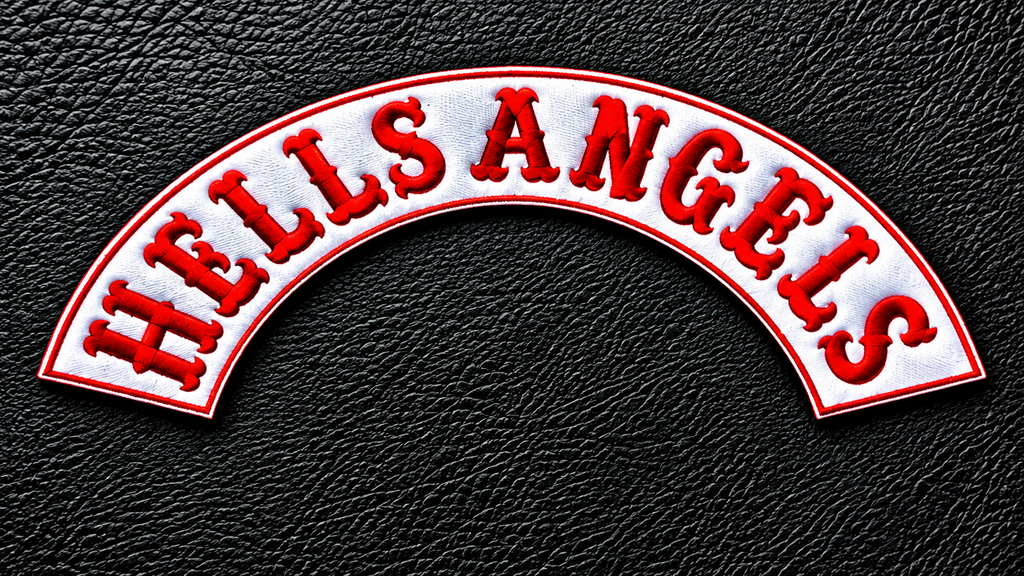
The top rocker is the curved patch across the shoulders. It reads “HELLS ANGELS” in red on white. Public accounts describe it as the last piece a member receives, at the ceremony known as “being patched.” The patches stay club property. A member who leaves is expected to hand them back.
Death Head Centre Emblem
The Death Head is a winged skull wearing an aviator-style helmet. It sits in the middle of the back patch and is the most recognisable piece of the set.
Who first drew it is less settled than most websites suggest. The club’s own history credits Frank Sadilek, a past president of the San Francisco charter. A legal commentary on an Australian Federal Court case refers to a 1954 drawing by a tattoo artist known as “Sundown,” used on a membership card. No source reviewed for this article reconciles the two accounts.
What’s better documented is how the design became standard. The Oakland charter, led by Sonny Barger, used a larger version first seen in 1959, nicknamed the “Barger Larger.” It later became the club-wide standard.
Bottom Rocker Patch
The bottom rocker names the place a chapter represents. That can be a city, province, state or wider territory. It’s how other riders read which chapter someone belongs to.
It can also read as a territorial claim. The 2015 Waco shooting in Texas is one example where a dispute over a state-name bottom rocker has been cited as a contributing factor. Public sources describe Hells Angels prospects as wearing a bottom rocker and MC tab before full membership, but practice can vary by chapter.
MC Patch
The small rectangular patch reading “MC” stands for motorcycle club. In the Hells Angels set it sits below the Death Head’s wing. Because of it, the full set is sometimes called a four-piece. Many other clubs use an MC tab too, usually to mark a traditional motorcycle club as opposed to a casual riding group.
81 Patch
81 is a letter code. H is the eighth letter of the alphabet and A is the first, so 81 means Hells Angels. It’s also a nickname for the club.
You’ll see 81 on “Support 81” caps, shirts and patches sold to non-members. The club’s website has been reported as saying non-members aren’t allowed to display the name and logo for personal use. 81 gives supporters a way to show support without doing that. It doesn’t prove membership.
AFFA Patch
AFFA stands for “Angels Forever, Forever Angels.” It’s the club’s traditional motto and points to lifelong membership, summed up as “once a member, always a member.” Some members wear an AFFA patch. Public sources describe no fixed convention for where it goes.
1% Diamond Patch
The 1% diamond is a diamond-shaped patch reading “1%.” Hells Angels members have worn a red-on-white version, and other outlaw clubs wear their own.
The usual story ties it to the 1947 Hollister, California, rally. Supposedly the American Motorcyclist Association (AMA) said 99 per cent of riders were law-abiding, and outlaw clubs claimed the remaining one per cent. But the AMA says it has no record of making that statement and calls the story apocryphal. So the origin is a popular tale rather than a documented fact. What’s documented is that some clubs wear the patch to mark an outlaw identity.
“Outlaw” first meant outside AMA-sanctioned clubs. Police agencies now use the term for groups they say are involved in crime, so the word carries different weight depending on who’s using it.
Filthy Few and Dequiallo: Disputed Meanings
Two small patches draw plenty of searches. Neither has a meaning the club has published.
- Filthy Few: Some law enforcement officials say it goes to members who committed, or were prepared to commit, murder for the club. Hells Angels figures have rejected that and described it as a merit badge for being first to arrive at a party and last to leave.
- Dequiallo: Police and prosecutors have reported that it signals the wearer fought law enforcement during an arrest. The name is generally linked to “El Degüello,” a bugle call tied to the Battle of the Alamo.
Treat both as allegations and interpretations, not confirmed facts.
What Is a Three-Piece Motorcycle Club Patch?
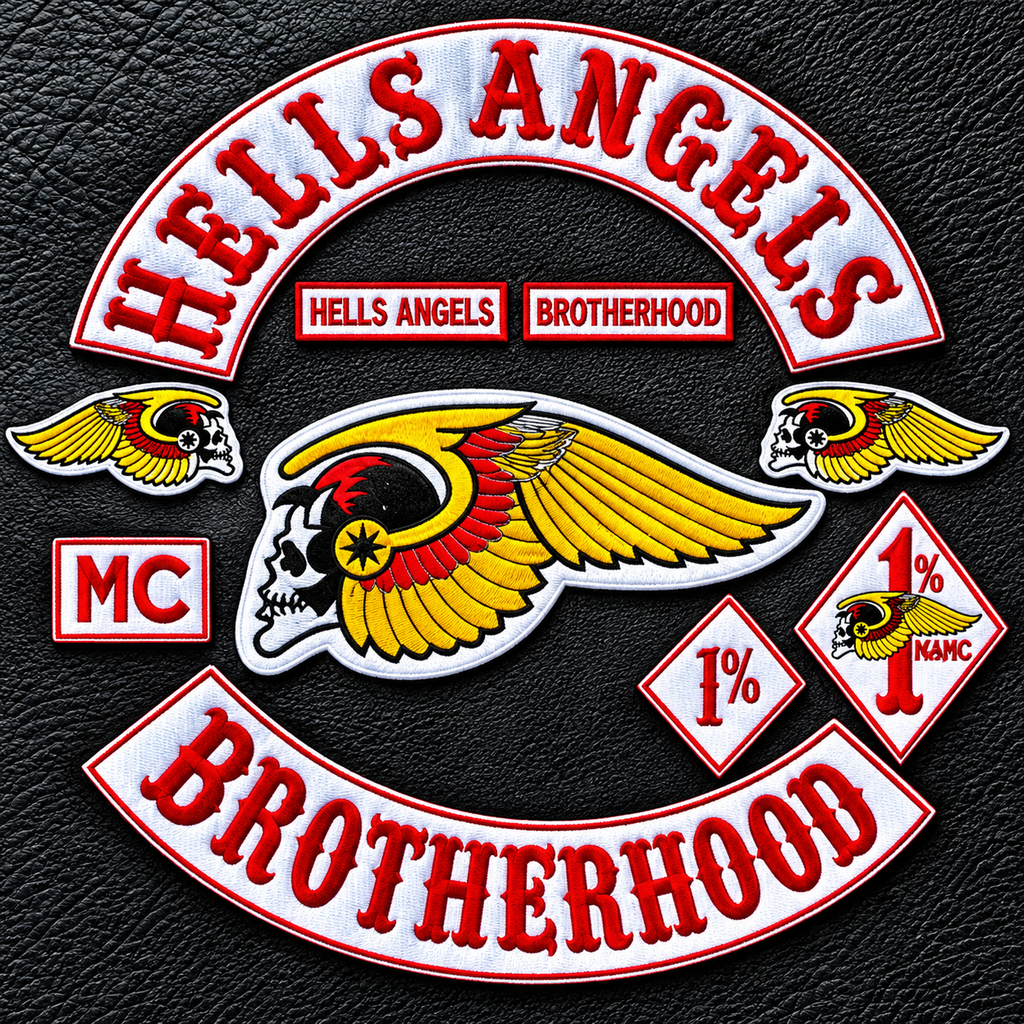
A three-piece patch is a back-patch format made of three parts: a top rocker with the club name, a centre emblem, and a bottom rocker with the chapter or territory. Rockers get their name from their curved shape. Traditional clubs usually add a small MC tab.
By convention, not law, the number of pieces says something about the group:
- One piece: common for social, family-oriented and AMA-style riding clubs.
- Two pieces: sometimes a club in transition, waiting for approval from established clubs in its area. Sources vary here.
- Three pieces: associated with traditional motorcycle clubs and outlaw clubs.
A three-piece patch doesn’t automatically mean an outlaw club. Many traditional clubs wear one. But because the bottom rocker can be read as claiming ground, some independent riding groups choose a different layout to avoid sending that signal.
What Do Motorcycle Club Patches Represent?
- Belonging. Colours show that someone is part of a group, and in many clubs the patches remain club property.
- Earned status. Hells Angels sources describe a staged path: hang-around, then associate, then prospect, then full-patch member. Other clubs have their own versions.
- Role. Officer patches such as president, vice-president, secretary, treasurer and sergeant-at-arms are documented in Hells Angels sources.
- Place. The bottom rocker ties a rider to a chapter and area.
- Memory. Years of membership, memorials and event patches record shared history.
Many clubs also treat colours with strict etiquette. Those rules differ from club to club, so general claims about what “all bikers” do are unreliable.
Hells Angels Patches in Canada
The Hells Angels arrived in Canada in 1977 with the Montreal charter and expanded across the country through the 1980s and 1990s. The Quebec biker war (1994–2002) was a violent conflict with rival groups. A Quebec prosecutor told a House of Commons committee it caused 174 deaths. Other sources put it above 160. It helped drive the 1997 and 2001 changes to the Criminal Code on criminal organizations, which include sections 467.11 to 467.13.
Criminal Intelligence Service Canada, among other agencies, classes the club as an organized crime syndicate. Club members have long said that crimes are the responsibility of individuals, not the club. Those offences are defined around conduct and what a group is for. This article doesn’t say whether wearing any particular patch has legal consequences, because that depends on the situation. It’s a question for a lawyer.
Hells Angels Patches vs Other Motorcycle Club Patches
| Hells Angels (public record) | Other clubs (general) | |
|---|---|---|
| Layout | Death Head, two rockers, MC tab | One-, two- or three-piece, varying by club |
| Who may wear it | Full members only; prospects wear partial sets | Set by each club’s rules |
| Support gear | “Support 81” and similar for non-members | Varies; many clubs have none |
| Legal protection | Active trademark enforcement | Varies widely |
| Territory | Bottom rocker names a place | Often, but not always |
These are tendencies, not rules. Clubs set their own customs, and they change by region and over time.
Are Hells Angels MC Patches Available for Custom Production?
No, not as copies. The Hells Angels Motorcycle Corporation owns the club’s name and Death Head imagery. It has described the Death Head in court filings as a collective membership mark. One IP commentary says it licenses its marks to charters and members and to no one else. Genuine club patches are for members.
The club has a long record of enforcing its marks. Examples:
- Disney (Wild Hogs): the suit was voluntarily dismissed after assurances.
- Marvel Comics: settled, with a donation to a children’s charity.
- Alexander McQueen: settled, with products pulled from sale.
- Toys “R” Us and a yo-yo maker: settled.
- Redbubble (Australia): the copyright claim failed on ownership grounds, but the club won on trademark and was awarded damages. The court looked at whether artwork was “deceptively similar” to registered marks, including versions shown at different angles.
Press reports based on seized club documents in Canada describe rules against selling anything with the logo without written consent from club headquarters.
Discussing these patches, as this article does, is different from manufacturing them. Making patches for your own club is also different. An independent club can have an original name, emblem and artwork. The safest route is a design that doesn’t borrow from another club’s imagery. Avoid winged skulls and look-alike layouts. Trademark and copyright rules vary by country, so check with a trademark lawyer or agent if you’re unsure. This isn’t legal advice.
How to Choose Custom Motorcycle Club Patches
If you’re outfitting your own club or riding group, these are the main choices.
Construction. Embroidered patches use stitched thread and have a raised, textured look that suits bold lettering and large designs. Woven patches suit finer detail and small text. Ask your maker which fits your artwork.
Size and shape. Measure the space on your vest or jacket and note the width and height. For a set, make the rockers and centre piece read as one unit. A merrowed (overlocked) edge finishes the border and helps prevent fraying.
Backing. Options include sew-on, Velcro, safety pin, adhesive and iron-on. Sew-on is the usual choice for thick leather or heavy denim, since heat-activated backing may not hold. Tell your maker if the garment is leather. See sew-on patches and Velcro patches for the differences.
Thread colours and artwork. Bold shapes and strong contrast read best from a distance. Tiny text and fine gradients can blur once stitched. Check the thread colour chart before you finalize, and proofread every word on the proof.
Use and durability. Think about sun, rain, washing and highway wind. Choose construction and backing for how the vest will actually be used.
About Stitch Patches Canada’s biker patch service. (This part is business information, not research.) Stitch Patches Canada makes custom biker club patches, including back patches and rockers, for clubs, chapters and riding groups. The page states that orders start at 25 patches per design and that it offers free design assistance, a design proof and free revisions. Customers are asked to confirm they have permission to use any logos or insignia they send in.
Frequently Asked Questions
What do Hells Angels MC patches mean?
They identify a member’s club, chapter and status. The top rocker names the club, the Death Head is the emblem, the bottom rocker shows territory, and the MC tab marks a motorcycle club. Smaller patches such as 81, AFFA and 1% add further meanings, though some are interpreted rather than officially published.
What does 81 mean in Hells Angels?
81 stands for the letters H and A. H is the eighth letter of the alphabet and A is the first, so it’s shorthand for Hells Angels. It appears on “Support 81” gear sold to non-members, and wearing it doesn’t mean someone is a member.
What is the Death Head patch?
The Death Head is the club’s winged-skull emblem, worn in the centre of the back patch. It’s a protected trademark of the Hells Angels Motorcycle Corporation, and full members wear it. Sources disagree on who first drew it.
What is a three-piece motorcycle club patch?
It’s a back-patch format with a top rocker for the club name, a centre emblem, and a bottom rocker for the chapter or territory. Traditional clubs use it, often with an MC tab. It doesn’t by itself mean a club is an outlaw club.
What does a bottom rocker represent?
It shows the territory or location a member’s chapter represents, such as a city, province or region. Because it can read as a territorial claim, some independent groups avoid it. For Hells Angels prospects, public sources describe a bottom rocker plus MC tab as the usual early patch, though practice varies.
Are all motorcycle club patches the same?
No. One-piece patches are common for social and AMA-style riding clubs, two-piece sometimes marks clubs in transition, and three-piece is associated with traditional and outlaw clubs. These are conventions rather than rules, and they differ by club, chapter and region.
Can motorcycle club patches be custom made?
Yes, for original designs using your own club’s name, emblem and artwork. Patches that copy another club’s protected insignia, such as the Hells Angels Death Head, shouldn’t be made. Stitch Patches Canada asks customers to confirm they have permission to use any logos or insignia they supply.
Are Hells Angels patches trademarked?
The club’s corporation holds trademark registrations for its name and Death Head and has taken legal action over unauthorized commercial use, including in the United States and Australia. Status varies by country, so check the Canadian Intellectual Property Office’s database or ask a trademark lawyer for specifics.
Final Thoughts
Hells Angels MC patches are easy to recognise and hard to interpret in full. The basics are well documented: the layout, the rockers, the Death Head, 81 and AFFA. The rest depends on who’s speaking, whether the club, police, courts or the press. When a source states a meaning with complete confidence, it’s worth asking where it came from.
For readers in Canada, the picture also includes local history and trademark law. If you’re planning patches for your own club, start from an original design rather than borrowed imagery. When you’re ready, you can request a quote with your artwork, size, quantity and preferred backing.