
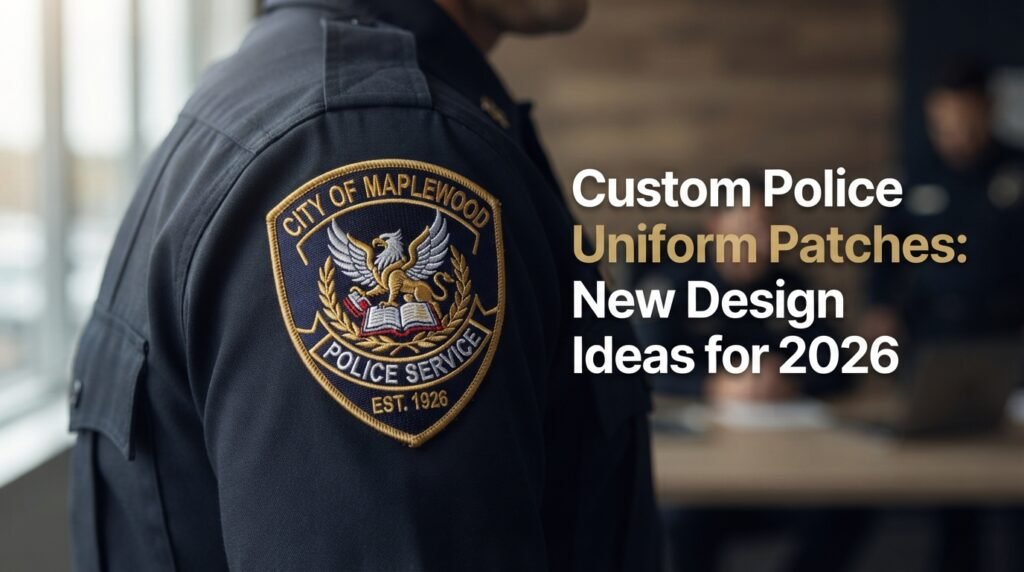
If you’re the person handling patches for your department or unit, here’s what actually matters before you order anything.
Quick answer
A good police uniform patch should be easy to read at its actual size and made with the right material and backing for how it will be used. This is useful for department staff, unit coordinators and anyone ordering or replacing police patches in Canada.
What makes a good police patch design
The biggest mistake people make is putting too much into the patch. A department name, a unit name, a motto, a symbol, maybe a small city outline, all crammed into something the size of a coaster. It looks fine on a screen. On an actual uniform, seen from a normal distance, it turns into a blur.
Start with the main symbol. This is usually the department badge, shield or crest, and it should be the first thing anyone notices. Everything else on the patch, the department name, the unit name, the border, should sit around that main element instead of pulling attention away from it. If you’re adding both a department name and a unit name, think about which one actually needs to be readable from a distance and which one can be smaller.
Borders matter more than people expect. A thin, clean border helps separate the patch from the uniform and gives it a finished look. A thick or overly decorative border can eat into space that would be better used for the main design.
Text is where most designs run into trouble. Once a design gets stitched down to actual patch size, small lettering can become hard to read, even if it looked fine on screen at full zoom. A word that seems perfectly clear on your monitor might turn into a fuzzy line once it’s on fabric. This is one of the most common reasons a finished patch disappoints someone who approved it without checking the real size first.
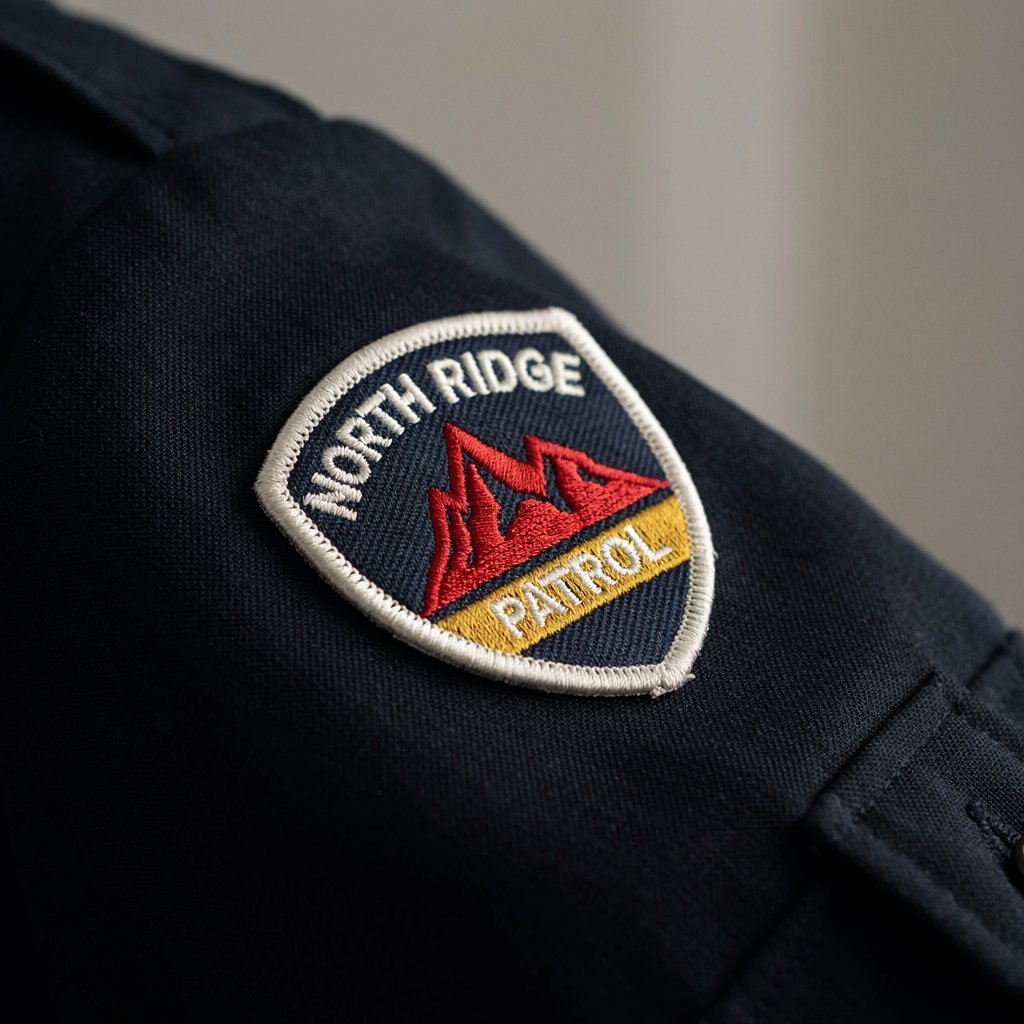
Before you approve anything, it’s worth asking to see a mockup or proof sized to the actual patch dimensions, not a zoomed in version on a screen. If you can hold your phone at arm’s length and still read every word clearly, that’s a decent test. If you have to squint, the text is probably too small.
Color matters mostly for contrast, not for looking flashy. Dark navy with gold or white lettering tends to read well from a distance. Two similar dark colors placed next to each other often blend into one shape once stitched, so they lose the contrast that makes a patch easy to identify quickly. If your department has official colors, those should usually take priority, but within those colors, contrast is still worth paying attention to.
Shield shapes and circles are still common for a reason. They’re easy to read, they fit standard placement spots on a uniform, and they don’t fight with the uniform for attention the way an unusual shape sometimes can.
Embroidered, PVC or woven, which one actually fits
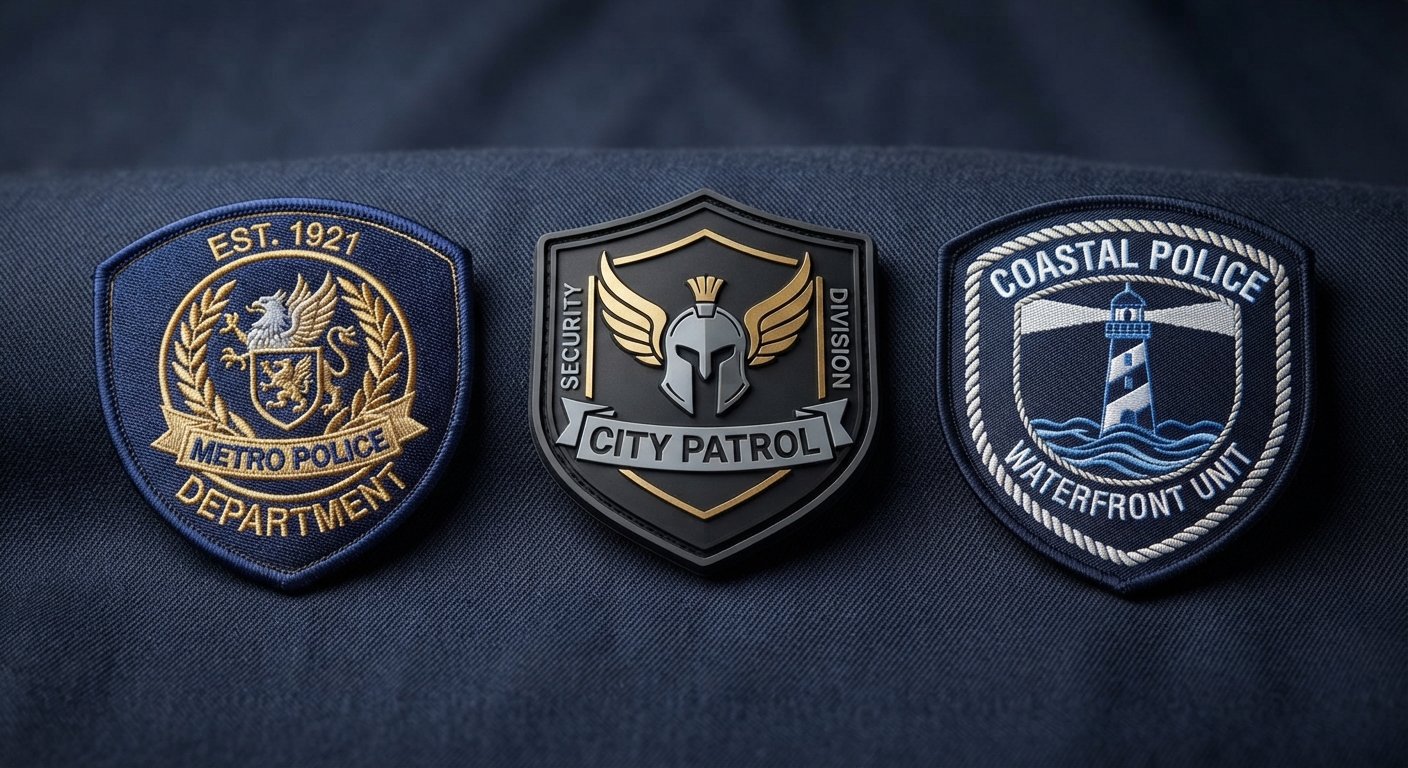
Embroidered is the traditional choice for daily uniforms. It has that raised, stitched texture people associate with a custom police patches, and it holds up fine through normal washing. If you’re outfitting patrol officers for everyday wear, this is usually the starting point. Where embroidered struggles a bit is with very fine detail or small text, since the stitching has a physical thickness that limits how tiny a line can get before it loses shape.
PVC makes more sense for gear that spends time outside or takes more wear. Vests, tactical gear, anything exposed to rain or rough handling. It’s moulded rather than stitched, so it holds up better against water and general wear than fabric does. The tradeoff is that PVC has a more modern, rubbery look that doesn’t always match the traditional feel departments want for dress uniforms, so it’s usually reserved for tactical or outdoor applications rather than a full uniform rollout.
Woven is worth considering when a design has small text or fine detail that embroidery tends to lose. If your patch has a motto in small print or a detailed crest, woven usually keeps those details clearer because the threads are thinner and lie flatter. Woven patches also have a smoother, less textured feel compared to custom embroidered patches, which some departments prefer and others don’t.
There’s no single right answer here. It comes down to what the patch has to survive and how much fine detail it needs to hold onto.
Sew on or Velcro, and how to actually decide
Sew on backing works well if the patch is staying on one uniform for good. It’s the more secure option and it holds up through repeated washing without loosening. Most standard patrol and dress uniforms use sew on for this reason, since the patch never needs to move once it’s attached.
Velcro makes more sense if the patch needs to move between different pieces of gear. Tactical vests are a common example, since officers might switch between different loadouts depending on the assignment, and Velcro lets the patch move with them instead of staying fixed to one item. Units that change assignments often, or that need to switch between visible and subdued patches depending on the situation, also tend to prefer Velcro for that flexibility. The custom Velcro patches check get more information.
A simple way to think about it. If the patch is staying put, sew it on. If it needs to move around between gear or change with the assignment, go with Velcro.
What to prepare before you order
You don’t need a finished design to get started. It helps to have a rough sense of what you want, even if it’s not fully worked out yet.
Useful things to have ready include an existing patch if you’re reordering, a photo of an old patch if the physical one is damaged or hard to find, a logo or artwork file if you have one, and any preferences on size, colours, backing type and quantity. None of this needs to be exact. A rough idea, a description, or even a sketch on paper is enough to start a conversation and get a proof put together.
If a design has a lot of small detail packed in, it often gets simplified before production. That might mean removing a small symbol, cleaning up thin lines, or enlarging small text so it actually reads once stitched. That’s not about changing the patch for the sake of it, it’s about making sure it still looks right once it goes from a digital file to actual fabric.
Patch ideas by unit
Patrol usually works best with a straightforward department shield, sized so it stays readable at a normal distance, since this is the patch the public sees most often during everyday interactions.
K9 units often go smaller, and Velcro backing is common here since patches sometimes move between the handler’s uniform and the dog’s own gear, depending on how the unit operates.
Tactical units tend to lean toward quieter, less flashy colours, since the goal is identification without drawing extra attention, and Velcro backing again comes up a lot here for the same reasons as vests.
Motorcycle units need something that can hold up to more movement and wear on jackets or outerwear, so material choice matters slightly more here than design complexity.
Marine units are usually better off with PVC, mainly because of how much water exposure the gear gets on a regular basis.
Specialized units often want a smaller secondary patch that pairs with the main department shield rather than replacing it, so it’s worth thinking about how a new unit patch will look next to the patches already on the uniform.
Can an old patch be recreated
Yes, and this comes up more often than you’d think. If the original patch is still around, even if it’s worn or damaged, it can usually be photographed and used as a reference to rebuild the design closely.
If the original artwork isn’t available and the physical patch is too damaged to work from clearly, it’s still often possible to recreate the design based on a clear photo, though very small or faded details might need to be reconstructed rather than copied exactly. In those cases, it helps to flag anything you specifically remember about the original, like exact colours or wording, since photos don’t always capture that accurately.
A note on Canadian requirements
Uniform requirements aren’t identical everywhere in Canada. What one province or department allows can be different somewhere else, and a lot of that comes down to internal policy that isn’t published anywhere public. It’s worth checking with your own department before approving final artwork, especially if this is a new design rather than a reorder.
It’s also worth knowing that official police and government insignia, including anything tied to the RCMP, can only be reproduced with proper authorization. A custom patch made for your own department or unit is a different situation.
Key takeaway
The best police patch is easy to read, made for the right uniform or gear, and finished with the backing that fits how it will be used.
FAQs
What size should a police shoulder patch be?
There’s no single fixed size. It depends on the department, the uniform, and where the patch is placed, so it’s worth checking what your department typically uses before finalizing anything.
Should I choose embroidered or PVC?
Embroidered for daily uniforms, PVC for tactical or outdoor gear that faces more wear and water exposure.
Is Velcro better than sew on?
Neither is better on its own. Sew on suits a patch that’s staying put. Velcro suits a patch that needs to move between different gear or change with an assignment.
Can a damaged old patch be recreated?
Usually, yes. A photo or a worn sample is normally enough to rebuild the design closely, even if the original is falling apart or the artwork file is long gone.
How much detail can be put on an embroidered patch?
Less than most people expect. Fine text and thin lines can lose clarity once stitched, so detailed designs are often simplified slightly to stay readable at actual size.
Can I order a small quantity of custom police patches?
Yes, small orders and reorders are both common, especially for units replacing a handful of worn patches rather than outfitting an entire department.
What should I have ready before requesting a proof?
An existing patch or photo if you have one, any preferences on colours and size, and the backing type you need. If you don’t have all of that yet, a rough idea is enough to start.
If you take one thing away from this, it’s that the best police patch isn’t the most detailed one. It’s the one that stays readable, holds up to how it’s actually worn, and fits how your unit operates day to day. Once you have a sense of the design, material and backing that makes sense for your situation, you can look into custom police patches built around your existing patch or a new idea, whichever stage you’re starting from.